

Heavenly Peace
The 1914 Christmas Truce and the Logic of the Incarnation

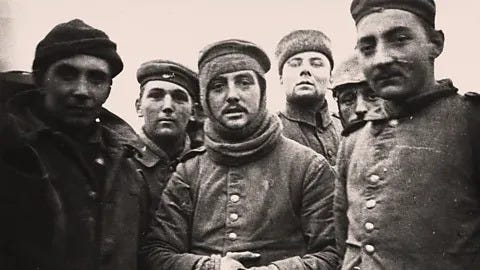
From the BBC’s story of the 1914 Christmas Truce of WW1 by Myles Burke:
On Christmas Eve 1914, Rifleman Graham Williams, of the 5th London Rifle Brigade, stood out on sentry duty staring out anxiously across the wasteland of no man’s land to the German trenches. He had already endured months of the brutal violence, bloodshed and destruction that would come to characterise World War One, when something remarkable happened.
“All of a sudden, lights appeared along the German trench. And I thought this is a funny thing. And then the Germans started singing ‘Stille Nacht, heilige Nacht’. And I woke up, and all the sentries did the same thing, all woke up the other people to come along and see this and what the Earth is going on,” he recalled, in the BBC radio show Witness History.
The voices carried across the desolation of no man’s land, familiar songs bridging the barrier of language, a musical reminder of a shared humanity. “They finished their carol and we applauded them and we thought we should retaliate in some way. So, we replied with The First Noel.”
Remarkably, this wasn’t the only “Christmas Truce;” small truces sprung up spontaneously along the battle lines. Some had dueling carols; in others, soldiers met one another, exchanged cigarettes and food, and even played [European] football:
The ceasefires allowed soldiers some respite to recover their dead from no man’s land and give proper burials to fallen comrades. Men who just hours earlier had been trying to kill each other exchanged cigarettes, food and souvenirs from home. There are even reports of impromptu games of football breaking out, with soldiers having a kick about in barren space between the opposing trenches. Col Johannes Niemann, a second lieutenant with the 33rd Saxon Regiment, was one of the soldiers who took part.
“Suddenly a Tommy came with a football… And then began a football match. We marked our goals with our caps. Tommy did also. And we had much kicking. And then, after all, the Germans won the football game 3-2.”
The peace was so remarkable that several officers put a stop to it, “fear[ing] they would erode their troops’ willingness to fight.” They even took measures in succeeding years to prevent more spontaneous truces from emerging, that the war might not be interrupted again.
Shared humanity through shared holiness
The article quotes historian Dan Snow calling the Christmas Truce “a brief tantalising flash of individual humanity” for the soldiers. And it was: rather than seeing one another as faceless abstractions to kill or be killed by, they met one another as fellow men, even as men who might have been friends.
But I think it’s interesting that in Rifleman Williams’ account, the first volley of the truce, as it were, is the German “Stille Nacht,” which we know in English as “Silent Night.” Here’s a direct translation of the first German verse:1
Silent night, holy night,
All is sleeping; alone awake
Is only the dear, most holy pair.
Gentle child with curly hair,
Sleep in heavenly peace!
Whatever they meant by their choice, the soldiers chose a song that marked this night, of all nights, as holy. Holy things belong to God: they’re set apart by him, for his purpose instead of ours. Soldiers up and down the lines recognized that if any day belonged not to the machinations of men but the mercy of God, it would surely be the day of his son’s birth. Their reverence for Jesus made them willing to consecrate Christmas by setting war aside.
And both the German and English versions end with the line, “Sleep in heavenly peace.” Whatever one thinks about the necessity of war on earth,2 the song recognizes that the life of heaven is peace. Peace reigns in heaven now, and peace will reign when the earth is reconciled with heaven in the new creation. If a holy day belongs to God, peace is a more fitting response than war.
The Pattern of the Prince of Peace
The shared moment of humanity came from a shared understanding of divinity. Whatever Christmas meant to the individual soldiers, Christmas existed because God the Son had been born as a baby to bring peace:
His name shall be called Wonderful Counselor, Mighty God, Everlasting Father, Prince of Peace. (Isaiah 9:6)
They shall not hurt or destroy in all my holy mountain; for the earth shall be full of the knowledge of the Lord as the waters cover the sea. (Isaiah 11:9)
While Christ’s kingdom clashes with Satan’s, there is war. While sin still poisons hearts and peoples, there will be war. But within the kingdom of heaven, within the heart and home of God, is peace. A culture shaped by centuries of celebrating the Prince of Peace making a home among us inspired these soldiers to let heaven’s peace interrupt their war. The BBC called it “miraculous,” which is exactly right. A miracle is when heaven breaks into earth for a moment; that is what happened over Christmas in 1914.
The Incarnation is the belief that God the Son became a human being. That he entered the world the way all of us do, as a baby dependent upon his mother. As Chesterton notes in The Everlasting Man, this isn’t just a fact; it’s a fact that changes us:
Any agnostic or atheist whose childhood has known a real Christmas has ever afterwards, whether he likes it or not, an association in his mind between two ideas that most of mankind must regard as remote from each other; the idea of a baby and the idea of unknown strength that sustains the stars. His instincts and imagination can still connect them, when his reason can no longer see the need of the connection … It is no more inevitable to connect God with an infant than to connect gravitation with a kitten. It has been created in our minds by Christmas because we are Christians; because we are psychological Christians even when we are not theological ones. In other words, this combination of ideas has emphatically, in the much-disputed phrase, altered human nature.
The mystery of God coming to dwell with humankind – of divine power being held in a poor mother’s arms – inevitably changes us. God “humanizing” himself, especially into a blue-collar family who become refugees, carries a logic that leads to humanizing others instead of dehumanizing them. Chesterton goes on to say,
After that moment there could be no slaves. There could be and were people bearing that legal title until the Church was strong enough to weed them out, but there could be no more of the pagan repose in the mere advantage to the state of keeping it a servile state. Individuals became important, in a sense in which no instruments can be important. A man could not be a means to an end, at any rate to any other man’s end.
(That little sound you hear is Tom Holland shouting “Amen!”)
If, as the carol says, the slave is our brother, then the Christian soldier on the other side of the line is as well; and the non-Christian is our neighbor. The miracle of the Incarnation produced the miracle of the Christmas Truce, a spontaneous recognition of the humanity of the enemy.
May the miracles multiply.
Merry Christmas!
Image: British and German soldiers meeting during the truce. From Harold Robson / IWM.
via ChatGPT; but checked other places
I’m not a pacifist – I think Romans 13 makes a case for the possibility of just violence from governments, which could include just wars – but I can understand Christians who are.